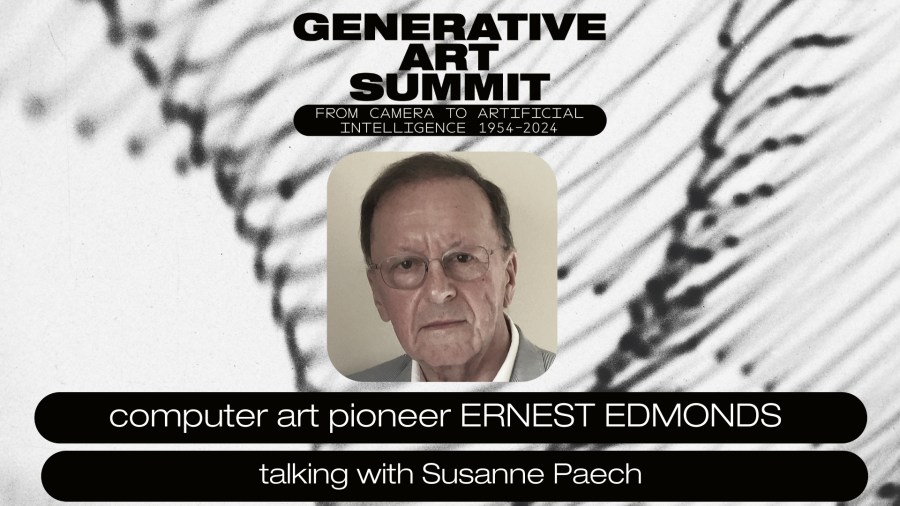
Before the Generative Art Summit in Berlin, a remarkable dialogue developed between Ernest Edmonds, a pioneer of computer art, and Susanne Paech, founder of the „art meets science – Herbert W. Franke Foundation“. Edmonds, whose career bridges the gap between mathematics and art, gave deep insights into the development of digital art and its intertwined relationship with technology and logic.
A Logical Progression from Mathematics to Art
Ernest Edmonds’s journey into the world of computer art began uniquely with mathematics. “The truth is I got into art before mathematics,” Edmonds confessed during the discussion. His passion for both fields during his school years led him to challenge academic norms and carve a path that would later revolutionize the art world. Despite initial resistance from his school, which pushed for a traditional focus on mathematics and physics, Edmonds managed to nurture his dual interests, attending evening art classes while pursuing a degree in mathematics.
This unconventional blend of disciplines heralded a new era of artistic expression. Edmonds recounted his early experiments in 1968, when he first applied computer programming to solve a complex artistic problem. This pivotal moment marked the beginning of his lifelong commitment to exploring the potential of computers as an artistic tool.
The Influence of Alan Turing and Systems Art
The discussion took a compelling turn when Edmonds touched on the influence of Alan Turing, the father of modern computing. Turing’s work on the theoretical underpinnings of computing resonated deeply with Edmonds, who has long viewed the computer not merely as a tool but as a medium for conceptual exploration in art.
Edmonds’s approach to computer art is heavily inspired by Turing’s ideas, particularly the concept that the essence of computing goes beyond physical machinery to encompass a broader conceptual framework. This perspective has guided Edmonds in exploring the abstract and structural possibilities of art through the lens of mathematical logic and computer algorithms.
Challenges and Criticisms within the Traditional Art World
The early days of computer art were not without challenges. Edmonds discussed the skepticism he faced from traditional artists and critics who questioned the legitimacy of computer-generated art. However, his affiliation with the Systems Art movement in the UK provided a supportive community that shared his interest in the mathematical foundations of artistic creation. Systems Art, known for its use of abstract and geometric forms guided by mathematical principles, provided a natural alignment with Edmonds’s own work.
The Future of Art in the Digital Age
Looking to the future, Edmonds is optimistic about the role of technology in art. He highlighted the increasing accessibility of digital tools that allow more people to engage in creative activities. While acknowledging that not all modern digital art is transformative, he emphasized the importance of both historical and everyday creativity.
Edmonds’s vision extends beyond mere digital proficiency; he advocates for a deeper understanding of the underlying processes that drive digital tools. This approach, he argues, can lead to more meaningful and innovative art that truly pushes the boundaries of traditional and digital media.
Concluding Thoughts
Ernest Edmonds’s contributions to art and technology are profound, not only in how they challenge our perceptions of what art can be but also in how they expand our understanding of the creative possibilities that technology can offer. As the digital landscape continues to evolve, his work remains a testament to the power of combining rigorous scientific method with the boundless realms of artistic expression. At the intersection of Turing’s legacy and the avant-garde of computer art, Edmonds’s career continues to inspire a future where art and computation exist in a symbiotic relationship, continually influencing and reshaping each other.
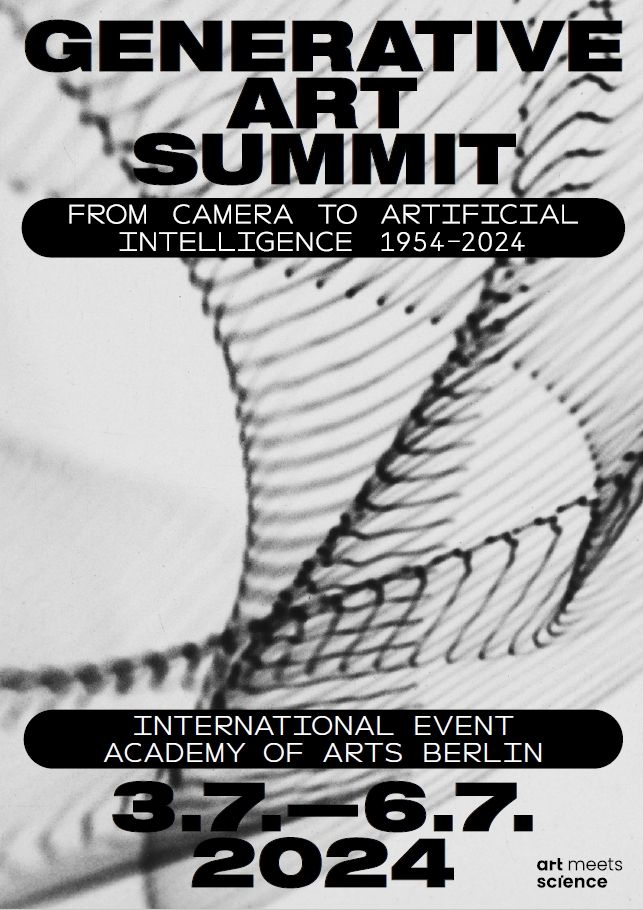
Good reasons to come to the Generative Art Summit in Berlin from 3 to 6 July.